
Ice Harvesting on Palmer Lake
By: Herbert “Hobie” Edwards
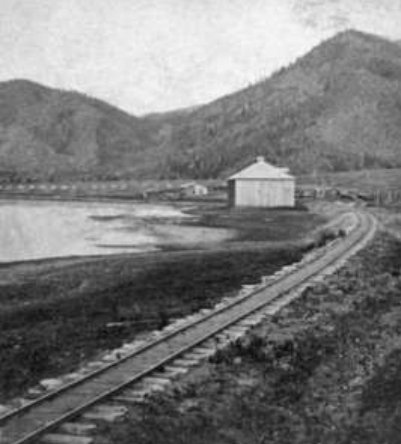
Ice harvesting began on Palmer Lake when in the fall of 1873 a group of English capitalists leased the lake from the Denver and Rio Grande Railroad and had an icehouse built on the northwest shore just south of the present fishing pier/platform/deck.
Sometime after the 1877 ice harvest and prior to the 1882 harvest, the D&RG took over Palmer Lake’s ice harvesting. It was reported in March 1882 that the D&RG had shipped “900,000 tons of ice …from the lake on the Divide,” which amounted to $30 to $40 worth of ice shipped daily. In 1883, the original icehouse was apparently torn down when the railroad deepened and enlarged the lake to approximately its present size.
In 1889, the railroad constructed facilities for a large-scale ice harvesting operation. A five-unit frame icehouse was constructed at the south end of the lake, along with a skidway, over 1,000 feet long. They also constructed ice handling machinery to get the cut ice into the houses plus icing platforms for loading the blocks of ice into freight cars. Ultimately, three spur tracks totaling over 4,000 feet in length were constructed to accommodate freight cars to be loaded with ice.
Reports of the ice cutting on Palmer Lake indicated that it was quite an operation:
January 1886: D&RG was “taking out forty cars of ice per day from Palmer Lake. The ice is eight inches thick and very clear.”
November 1888: “The ice crop at Palmer Lake is worth about $3,000 a year.”
December 1897: “The D&RG expects to ship out 1,000 cars (of ice).”
February 1899: “The ice crop at Palmer Lake, in regular figures, shows that 18,000 tons of ice was cut. Four teams [of horses] were employed [to cut ice] and about forty men assisted.”
Ice harvesting was dangerous work according to newspaper accounts.
February 1900, “A boy named George Elliot, who was running an ice cutting machine on the lake, was dragged under by the ice giving way under his horse [pulling an ice plough]. The boy and horse were rescued with difficulty.”
January 1915, “Mr. Harry Street, who has been working on the ice, was badly hurt, Friday afternoon, when he slipped and fell on an ice saw. Four points entered his side about an inch, and it was necessary to take several stitches.”
February 1916, “L. W. Chase was the only one who fell through the ice this winter while it was being cut.”
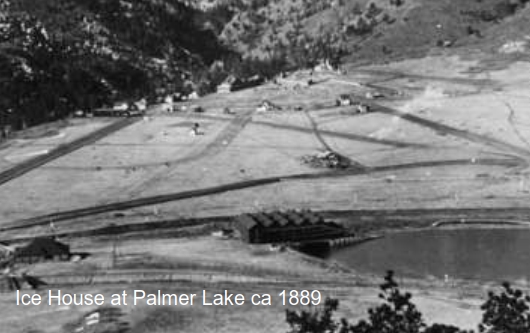
Disaster struck on May 17, 1908, when the railroad’s large wooden ice houses at the south end of the lake were destroyed by fire, which included 6,000 tons of ice. The damage was estimated to be from $10,000 to $30,000.
The Colorado Springs Gazette, in November 1908, reported, “Jewelry to the value of $600 lies hidden under the chute of the icehouse at Palmer Lake, according to the confession of W. D. White, a cat burglar, who told Sheriff O. P. Grimes that he had secreted much of his booty when he robbed the D&RG freight car at Palmer Lake two years ago and took more than $1,000 worth of medals and jewels.” It is interesting to note that the icehouse had burned that previous May.
Exactly when the D&RG stopped cutting and/or using its ice facilities at Palmer Lake is unclear. Since some of the structures remained in place until 1926, it is possible that ice was cut by private contractors with the permission of the railroad. In December 1926, the railroad officially retired its icing facilities at Palmer Lake, ending over 50 years of formal ice harvesting on the lake of which 40 involved the railroad itself.
D&RG built the First (Lower) Reservoir in North Monument Canyon in 1887 and according to newspaper accounts, at least in 1902 ice was cut from the reservoir. In January, it was reported that the ice was “fine and clear as window glass and twelve inches thick.” A D&RG representative estimated that there was enough ice to cut to fill 25 railroad cars. The Second or Upper Reservoir was completed in 1905. There are no accounts of ice being harvested from it.
THE GLEN’S ICEHOUSE
At some point, a large icehouse was built in the Glen, which stood opposite the picnic grounds on the north side of Lover’s Lane. Constructed of logs and large timbers, it remained until the late 1940s or early 1950s. This may well have been the place where the ice was kept until delivered to local stores and some houses in town until electric refrigeration became somewhat common. Today, absolutely nothing remains of the Glen’s icehouse.
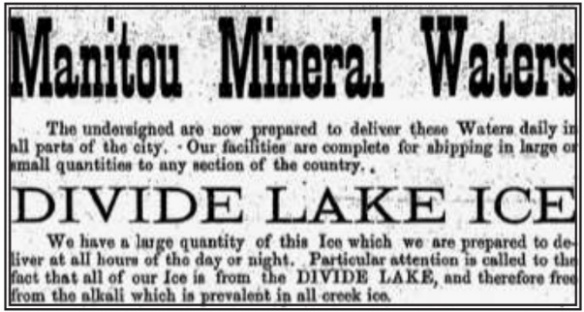
Appeared in a paper in April, May and July 1877